




| No.285 March 2026 | Monthly Newsletter |
Peel Hall Higher Ince |
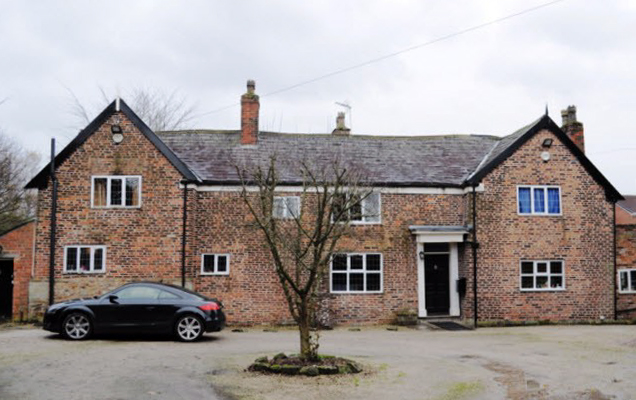 Could this house be the oldest building in Wigan? The current residents Barry and Carol Conway certainly think so, as did the previous owners John and Janet Poulson. They have good reason to think it too, but don't be fooled by its external appearance as its internal structure is a timber frame. In a 1983 Post & Chronicle article (discovered by Ron Hunt of WiganWorld) John Poulton describes a meeting with a team of archaeologists from Manchester University. During renovations he had uncovered wattle and daub under wallpaper and huge timbers in one of the bedrooms. His own research had revealed a deed which granted the house and land to Henry de Childres in 1300. The guys from the University told him that the timbers indicated the building was originally of a cruck frame construction, which reinforced its suspected age. There have obviously been many changes over the years, including brick replacing wattle and daub for the outside walls. The building in fact was surveyed in 1981 by N W Alcock for a book published by the CBA on Cruck Construction. His research suggested the Hall may have been owned by the Brown family, freeholders in the late 14th and 15th centuries. Cruck framed buildings date from as early as the 13th century and there are a number recorded in the Wigan area. The best known is Kirkless Hall, less than a mile away from Peel Hall in Aspull. Similar to Peel it sits next to the flight of lock on the Leeds & Liverpool Canal (which was completed btw in 1816). Despite displaying a 1663 datestone, Kirkless Hall is also thought to date from the 14th century. Alcock says it was owned and occupied by the Houghton family from the early 14th century until the 18th century. Some of our members visited this Hall in 2015 as part of our investigations into the nearby Wigan Coal & Iron works (Newsletter 162). The owner kindly invited us in and we saw that he was also in the stages of renovating the interior and had discovered the timbers blades of the cruck framing during the process. Interestingly the exposed cross brace timbers displayed elaborate carvings on them which looked to be Tudor in style. 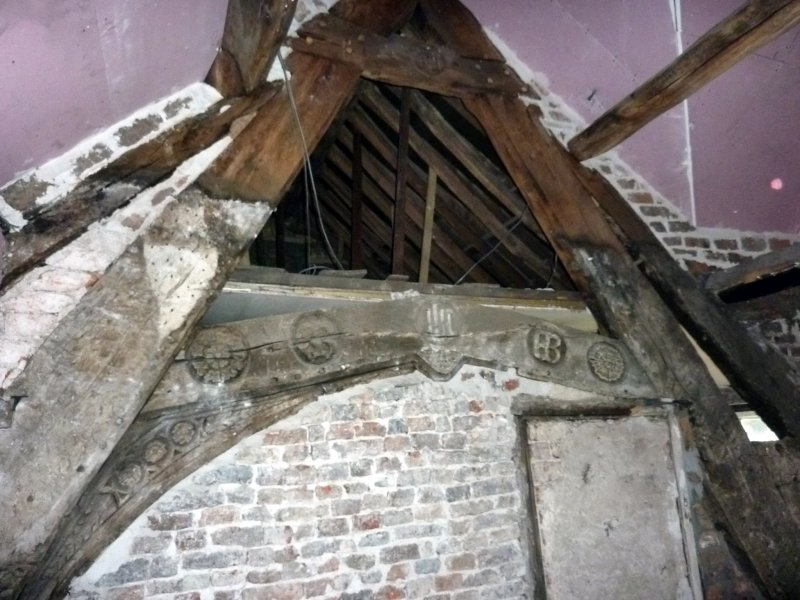 Both Kirkless Hall and Peel Hall had moats around them, reinforcing their Medieval origins. Moats were a common feature in this region at the time, 17 being recorded in the Wigan Borough alone. The moat at Peel was filled in between the wars, but still shows signs of where it was when it rains. Meanwhile Barry and Carol have been carrying out their own research and discovered many details of the Hall's use over the many centuries. For instance, it was originally called Ince Hall but then in the 1600s was renamed Old Ince Hall when the owners built New Ince Hall on what is now the other side canal. At one time it became a pig farm before being sold and renamed Peel Hall. Various reconstructions took place over the years including an annex added for rental purposes and also a barn to store grain. Apparently in the 19th century miners queued outside the back of the house, crossing a bridge leading from the canal to receive their wages. This Grade II listed building certainly has had quite a history. As for the oldest structure in Wigan, the prize almost certainly goes to the Parish Church Tower which Peter Layland has shown to date from the late 13th century. Treasure: History UnearthedThere's still places available on this trip to Liverpool Museum to see this unique exhibition on Sunday 15th March. If you can't make that date, you may be interested in a daylong conference on Saturday 21st March on the 'stories behind the finds'. You can book the full day, or just attend individual talks on specific items in the exhibition. Booking all 7 talks cost £35.00 (£31 concession) with £7 for each talk (£6 concession) - full details on their website. Next MeetingWednesday 4th March - at the Real Crafty on Upper Dicconson Street starting at 7.30pm as usual. This month we have Rachael Tynan who has been a regular volunteer on our site at Aspull. She is currently studying archaeology and German at Liverpool University, but I was also surprised to learn that she was a member of a group in Liverpool practicing Historical European Martial Arts (HEMA) - in fact she teaches the techniques there. Her talk is entitled 'The History and Use of the Medieval Long Sword'. She's obviously well versed in the handling as well as the history of this historically important weapon - a talk not to be missed, hope to see you there - BA. |